Quantum computers just crossed a red line. When NIST approved three post-quantum encryption standards on August 15, 2024, it effectively started a countdown for every blockchain. Some teams didn’t wait—they already ship code signed with Falcon, Dilithium, or XMSS keys. In this guide, you’ll meet five projects that have real, running post-quantum defenses and learn which path best fits your 2026 security roadmap.
Five quantum-resistant blockchain projects worth watching in 2026
Quantum hardware is catching up to RSA and ECDSA keys. NIST underscored that risk on August 15, 2024, by adding Dilithium, Falcon, and SPHINCS+ to the Federal Information Processing Standards register.
The projects below already sign or verify data with at least one of those algorithms, giving you a practical shield well before the anticipated “Q-Day.” Scan their approaches, compare strengths, and decide which strategy aligns with your risk profile.
Project 11: a quantum safety net for Bitcoin
Bitcoin’s cryptography is notoriously hard to upgrade, so Project 11 Applied Quantum Computing built Yellowpages, an open-source registry that links a user’s current address to a post-quantum key without touching the base chain (raised $6 million from Variant, Quantonation, and Castle Island).
Why it matters: on-chain research shows about 6.36 million BTC—roughly 33 percent of supply—sit in outputs where the public key is exposed, making them prime quantum targets. By recording proof of ownership today, you can reclaim those coins even if Shor-level machines emerge tomorrow.

Project 11’s Yellowpages overlay links exposed Bitcoin outputs to post-quantum keys, creating a safety net ahead of quantum attacks.
Project 11 keeps the fix simple. Custodians install a command-line tool (CLI) in minutes, with no forks or wallet migrations.
According to Project 11’s Yellowpages trust-model documentation, the client generates new post-quantum key pairs from a 24-word seed phrase, links them to your existing Bitcoin addresses with signed messages, and then wraps those ownership proofs in a trusted execution environment before encrypting them with post-quantum ML-KEM so they are not exposed to harvest-now-decrypt-later attacks.
The team is auditing NIST-standard Dilithium, Falcon, and XMSS to select the scheme for version 1.0, and public code reviews plus hardware-wallet integrations are scheduled before 2026. If you manage client BTC, tracking those releases and the evolving Yellowpages trust model is smart risk management.
Quantum Resistant Ledger (QRL)
QRL launched in 2018 as the first public chain secured by hash-based XMSS signatures, so every address has post-quantum protection from day one.
After seven years online, the chain has never needed a security hot-fix. The team does acknowledge XMSS trade-offs: larger signatures and stateful “one-time” keys that add wallet friction. Those lessons drive Project Zond, a Q4 2025 upgrade that will add stateless SPHINCS+ smart contracts and an Ethereum-style virtual machine, now running in public testnet.
For node operators, the benefit is continuity. If a quantum attack landed tomorrow, QRL would keep producing blocks on commodity hardware, with no emergency fork or wallet migration. Throughput sits around 70 TPS today, and a hash-secured layer-2 rollup is planned to raise capacity without reducing post-quantum guarantees.
In a space where “quantum-ready” often stays on paper, QRL provides battle-tested code, public audits, and a clear path to quantum-safe DeFi.
QANplatform
QANplatform offers a quantum-ready Layer 1 with Dilithium-signed accounts, full EVM compatibility, and a private-chain edition for on-premises use. Developers can deploy Solidity, Python, or Go contracts without rewriting them for new keys.
The project secured $15 million from MBK Holding in April 2024, funding audits and a public testnet that launched the same month. In May 2025, an EU ministry began piloting QAN’s stack for critical-infrastructure software, citing NIST alignment and local hosting options.
Architecture: a hybrid proof-of-stake network. Public validators run the open chain, while permissioned clusters process up to 3,000 TPS internally, then anchor state to the public ledger with a single checkpoint to prevent data leakage.
Regulators are already asking for quantum-migration plans; QAN delivers one that works today, with no retrofit required.
Algorand
Algorand proved post-quantum security at scale on November 3, 2025, broadcasting the first mainnet transaction signed with Falcon-1024, a lattice-based signature chosen by NIST.

Algorand is the first major Layer 1 network to broadcast mainnet transactions signed with Falcon-1024.
Falcon already protects Algorand state proofs, the compact certificates generated every 256 rounds that let bridges and light clients verify chain history. Regular accounts still use Ed25519, yet developers can create Falcon key pairs with an open-source CLI and send quantum-safe transactions today with no protocol fork.
Next, the core team is adding Falcon verification to the Algorand Virtual Machine so dApps and multisig wallets can adopt PQC with just two SDK updates instead of full rewrites. With roughly 10,000 TPS and 2.8-second block times, Algorand shows that speed and post-quantum security can coexist.
Hedera Hashgraph
Hedera’s 29-member council, which includes Boeing, Google, and IBM, votes on every network upgrade and gives the ledger enterprise-grade change control.
On the cryptography side, Hedera anchors system IDs with SHA-384, a hash length approved in the NSA’s CNSA 2.0 rules for Top-Secret traffic. In December 2024, Hedera partnered with semiconductor firm SEALSQ to test the QS7001 secure chip. The chip stores post-quantum keys and signs transactions inside tamper-resistant silicon. First production units are planned for 2025.
Why focus on hardware? Many regulated industries must use FIPS-validated modules when they update cryptography. With QS7001, a bank can replace the board, restart nodes, and adopt NIST-standard Dilithium signatures as soon as the council approves them, with no middleware rewrite.
If your compliance checklist calls for both quantum-safe algorithms and auditable governance, Hedera gives you a clear path from SHA-384 today to full Dilithium keys in the near future.
How the contenders stack up
Below is a snapshot of each project’s post-quantum posture as of January 2026. Use it to match technical fit with your security goals.
| Project | PQC algorithm in production | Network status (Jan 2026) | Consensus / type | Primary advantage | Source |
| Project 11 | XMSS or Dilithium (audit wraps Q2 2026) | Yellowpages beta live | Bitcoin overlay | Protects about 6.36 million BTC already exposed to public keys | theqrl.org |
| QRL | XMSS today; SPHINCS+ VM in public testnet | Mainnet since 2018 | Proof-of-Work L1 | Seven-year security record with zero critical patches | coinmarketcap.com |
| QANplatform | Dilithium | Public testnet v2, private chain live | Hybrid PoS L1 | Multi-language smart contracts and on-prem option | qanplatform.com |
| Algorand | Falcon-1024 (state proofs every 256 rounds) | Falcon transactions live Nov 2025 | Pure PoS L1 | First top-30 coin running NIST signatures on mainnet | algorand.com |
| Hedera | SHA-384 hashing; Dilithium via QS7001 hardware (pilot 2025) | QS7001 rollout slated H2 2025 | Hashgraph DLT | Fortune 500 governance plus FIPS-grade hardware path | hedera.com |
Key takeaways
- Compliance-focused teams often choose Hedera or QANplatform.
- Holders seeking zero-migration assurance tend to favor QRL or Project 11.
- If deep liquidity is essential, Algorand offers an immediate option.
Future outlook: from standards to migration day
Quantum risk is now on regulators’ calendars, not in science-fiction novels. Europol’s Quantum-Safe Financial Forum warned in February 2025 that banks should start inventorying vulnerable keys today, even though practical quantum attacks may be 10–15 years away. The U.S. government has likewise ordered federal agencies to be “quantum-resistant” by 2035.
Three forces will shape the next 24 months (January 2026 – December 2027):
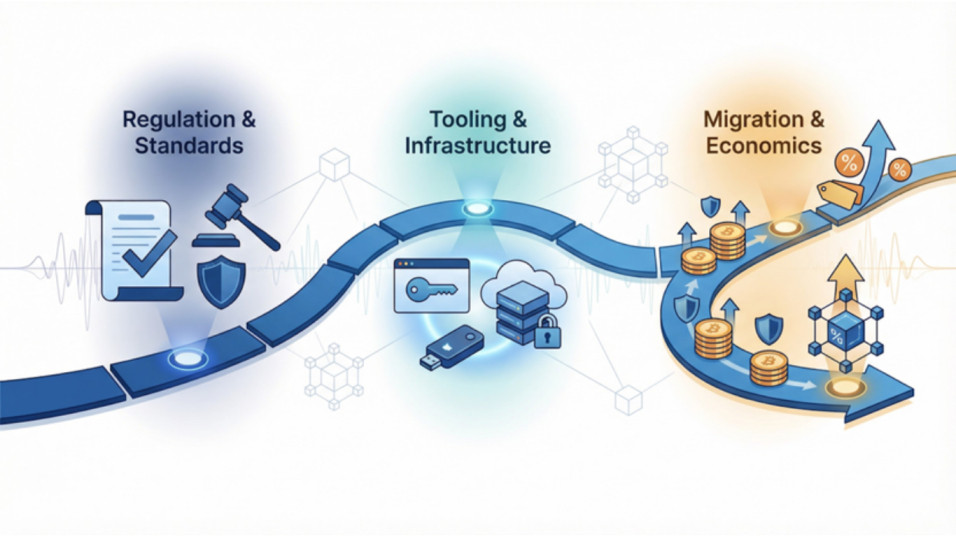
Regulation, tooling, and migration economics will determine how quickly blockchains move to quantum-safe cryptography.
Regulation moves first. Draft EU and U.S. guidance already asks custodians to document quantum exposure; once those drafts harden into rules, exchanges will need audit trails showing Dilithium-, Falcon-, or XMSS-protected keys. The five projects in this guide double as an instant compliance checklist.
Tooling goes mainstream. At least four Chrome-store wallets and two cloud-HSM vendors added post-quantum curves in 2025 alone. As browser extensions and hardware wallets adopt PQC by default, “wait-and-see” becomes a harder stance to justify.
Migration economics bite last. Millions of cold wallets, multisig contracts, and dust addresses still use ECDSA. Expect bounties and fee rebates—plus Bitcoin’s eventual PQ soft-fork—to coax stragglers. Tools like Project 11’s Yellowpages are already rehearsing that mass-migration playbook.
Debate over timelines is fading; the new question is execution speed. The standards exist, the software is shipping, and the regulatory clock is ticking.
Conclusion
The guide outlines five practical paths to quantum-safe blockchain operations, each with distinct strengths. Align these options with your organization’s risk tolerance, compliance obligations, and technical roadmap to stay ahead of the quantum curve.
Article received on email