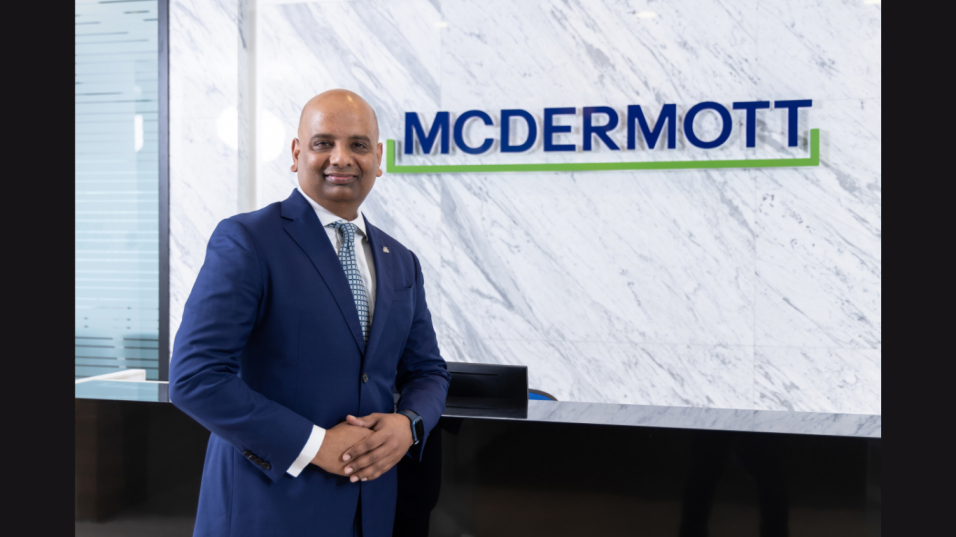
McDermott’s Subsea and Floating Facilities business line has achieved a triple victory at the World Business Outlook Awards 2026. The Singapore-based publication has named it the Offshore EPCI Contractor of the Year Asia 2026 and the Offshore EPCI Contractor Team of the Year Asia 2026, while honouring Mr. Mahesh Swaminathan, McDermott’s Senior Vice President and Executive Committee Member, as the Energy Industry Contractor Executive of the Year Asia 2026. These accolades celebrate the company’s business line operational excellence, integrated engineering, procurement, construction and installation (EPCI) expertise and execution leadership across Asia’s dynamic deepwater frontiers. Under Mr. Swaminathan’s leadership, the business line has consistently delivered complex deepwater infrastructure while championing workforce empowerment and digital innovation. In this exclusive conversation, World Business Outlook sits down with Mr. Swaminathan to explore how strategic discipline, collaborative culture, and agility continue to power McDermott’s regional and global success.
Q1. Congratulations on being named Energy Industry Contractor Executive of the Year Asia. What core leadership principles have guided you in steering McDermott’s Subsea and Floating Facilities through complex offshore market dynamics, and how do you ensure the business remains agile in meeting client demands across Asia and globally?
Mahesh Swaminathan: One of the things I am most proud of is how our deepwater business has evolved over the past 15 years. During that period, we have grown into a leading global deepwater EPC contractor by staying focused on our customers, investing in our people, and executing consistently in some of the world’s most complex offshore environments. A significant part of that growth journey has been led from Australasia, with Kuala Lumpur evolving into one of our principal execution hubs, working alongside London and supported by project offices in Perth and Rio de Janeiro. McDermott’s long-standing presence in Malaysia, which spans nearly five decades, has provided an exceptional platform from which to build global capabilities and attract world-class talent.
The leadership principles that have guided me throughout this journey are relatively simple: stay close to the customer, empower people to make decisions, and maintain execution discipline. Upstream energy projects are constantly influenced by changes in regulatory environments, energy demand, supply chains, and technology, but our customers consistently seek the same outcomes: safety, certainty, reliability, and value. To remain agile, we engage early with customers to understand their objectives and challenges, while leveraging our integrated EPCI model to optimize projects from concept through installation and commissioning. By bringing engineering, procurement, fabrication, marine operations, and project execution together under one organization, we are able to respond quickly to changing market conditions while maintaining alignment across the project lifecycle.
McDermott’s century-long heritage gives us a strong foundation, but our success has never been about history alone. It is about continuously evolving to meet our customers’ needs. Today, that means combining global expertise, regional insight, strategic partnerships, digital innovation, and an integrated execution model to deliver projects safely, efficiently, and with greater certainty. By keeping people, projects, and performance at the center of every decision, we continue to position our business for sustainable growth across Australasia and around the world.
Q2. Winning Offshore EPCI Contractor Team of the Year recognizes your teams’ cross-functional strength. How do you foster seamless collaboration and high-performance execution across globally distributed teams while maintaining world-class safety and quality standards on high-stakes projects?
Mahesh Swaminathan: One of the characteristics that sets McDermott and the deepwater business I lead apart is our global operating model. For many companies, engineering centers in Australasia primarily serve as support organizations. For us, Kuala Lumpur is much more than that. It is one of our principal hubs for strategic decision-making, engineering and project execution, working alongside London and supported by project offices in Perth and Rio de Janeiro. This model allows us to place talent and expertise close to our customers and projects while maintaining the agility and consistency required to deliver deepwater projects anywhere in the world.
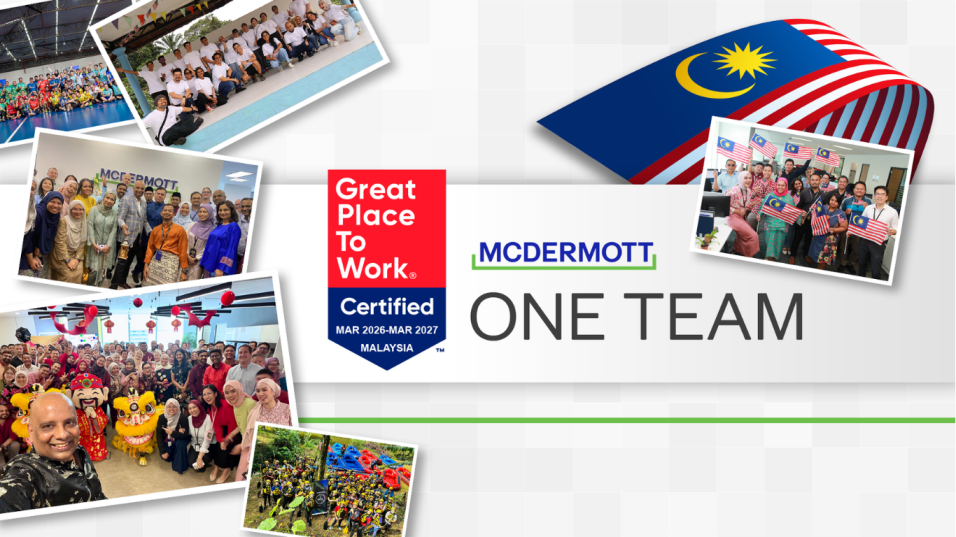
Our growth has been made possible by creating a truly integrated organization that operates across offices, project sites and vessels as one team. Whether engineering is performed in Kuala Lumpur, marine operations take place offshore Brazil or fabrication is underway in one of our yards, our teams work through unified systems, processes and performance expectations. This enables us to mobilize expertise quickly and transfer lessons learned across regions. Safety and quality are the foundations that connect this global organization. Our health and safety culture is not simply a framework but a shared responsibility embraced across every office, yard and vessel. We empower people to speak up, challenge assumptions and take ownership of safe, high-quality outcomes. Just as importantly, our people have selected McDermott in Malaysia as a Great Place to Work for two consecutive years, providing meaningful recognition of the culture we are building together. In my experience, the highest-performing teams recognize safety, quality and execution excellence as inseparable objectives. By fostering trust, accountability and collaboration, we have built a culture capable of delivering some of the industry’s most complex offshore projects while maintaining the standards our customers expect.
Q3. Asia’s offshore landscape presents distinct logistical, environmental, and technical challenges. How has McDermott’s regional experience shaped its execution approach, and how do those lessons translate on a broader global stage?
Mahesh Swaminathan: Australasia has played a defining role in shaping our business and approach to project execution. As I mentioned, over the past decade, the region has become a well-established base for the EPC delivery of large subsea and FPSO projects to customers around the world. We are charting a similar course for our deepwater business, building on the regional talent, execution discipline and global delivery capabilities developed through our experience operating across the region.
Operators are often balancing the need to maximize production from existing brownfield assets while simultaneously developing new greenfield resources to support long-term energy security. Projects must navigate diverse regulatory frameworks, demanding logistics, evolving local content requirements, varied metocean conditions and increasingly complex technical scopes. As part of our project execution approach, we partner with local companies to transfer knowledge, strengthen their technical and delivery capabilities, and support their development into world-class businesses in their own right. We also focus on training the next generation, with programs catering to graduates to learn on the job from day one.
What we have learned in Australasia has proven highly relevant on a global scale. Whether supporting mature offshore basins seeking to extend asset life or helping customers unlock new deepwater developments, many of the same challenges apply: maximizing value from existing infrastructure, improving capital efficiency, reducing schedule risk and accelerating time to first production. Our experience delivering projects across Australasia has strengthened our ability to solve these challenges and apply those lessons in other regions around the world, from brownfield optimization and tiebacks to large-scale greenfield field developments. As energy demand continues to grow, we believe our proven expertise positions us exceptionally well to help customers deliver the next generation of offshore projects.
Q4. As deepwater field developments grow technically demanding, how is McDermott deploying digital engineering, advanced simulation, and vessel optimization to compress delivery schedules and maximize marine installation efficiency?
Mahesh Swaminathan: The offshore sector has always been driven by engineering innovation, but today digitalization is becoming equally important in enabling successful project delivery. Our approach is focused on using digital tools to improve decision-making across the project lifecycle. We continue to invest in model-based engineering, digital project execution platforms, advanced simulation tools, and data-driven planning capabilities that enable greater visibility and alignment between engineering, procurement, fabrication, and offshore installation teams. These technologies help us identify risks earlier, optimize project schedules, and the deployment of our marine assets, including Amazon and DLV 2000, helping us execute complex offshore campaigns with greater predictability and operational efficiency. Ultimately, digitalization is about enabling smarter execution, strengthening project certainty, and delivering better outcomes for our customers in increasingly complex offshore environments.
Q5. Looking ahead across the region over the coming years, how is McDermott positioning its subsea capabilities and installation fleet to balance domestic energy security with emerging low-carbon infrastructure?
Mahesh Swaminathan: The Australasia region is entering a pivotal period for offshore energy investment. Across the region, governments and operators are working to strengthen energy security while advancing their long-term decarbonization ambitions. As a result, we see two major trends developing in parallel: continued investment in natural gas infrastructure to meet growing energy demand and growing interest in offshore infrastructure supporting carbon management, electrification and energy transition initiatives.
Natural gas is expected to remain a critical part of the region’s energy mix for the foreseeable future. Many of the developments moving forward today are becoming more technically complex, requiring longer tiebacks, deeper water installation capabilities, more sophisticated subsea infrastructure, and increasingly integrated project execution. These are areas where McDermott has extensive experience to support operators seeking to bring new resources online.
At the same time, many of the capabilities developed through decades of offshore project delivery are directly applicable to the next generation of energy infrastructure. Whether supporting carbon capture developments, or other emerging opportunities, the industry continues to rely on the same fundamentals: complex engineering, marine operations, large-scale fabrication, subsea installation, and disciplined project execution. We see these opportunities as complementary rather than competing priorities.
Looking ahead, our strategy is centered on maintaining the flexibility to support both energy security and energy transition objectives for our customers globally.