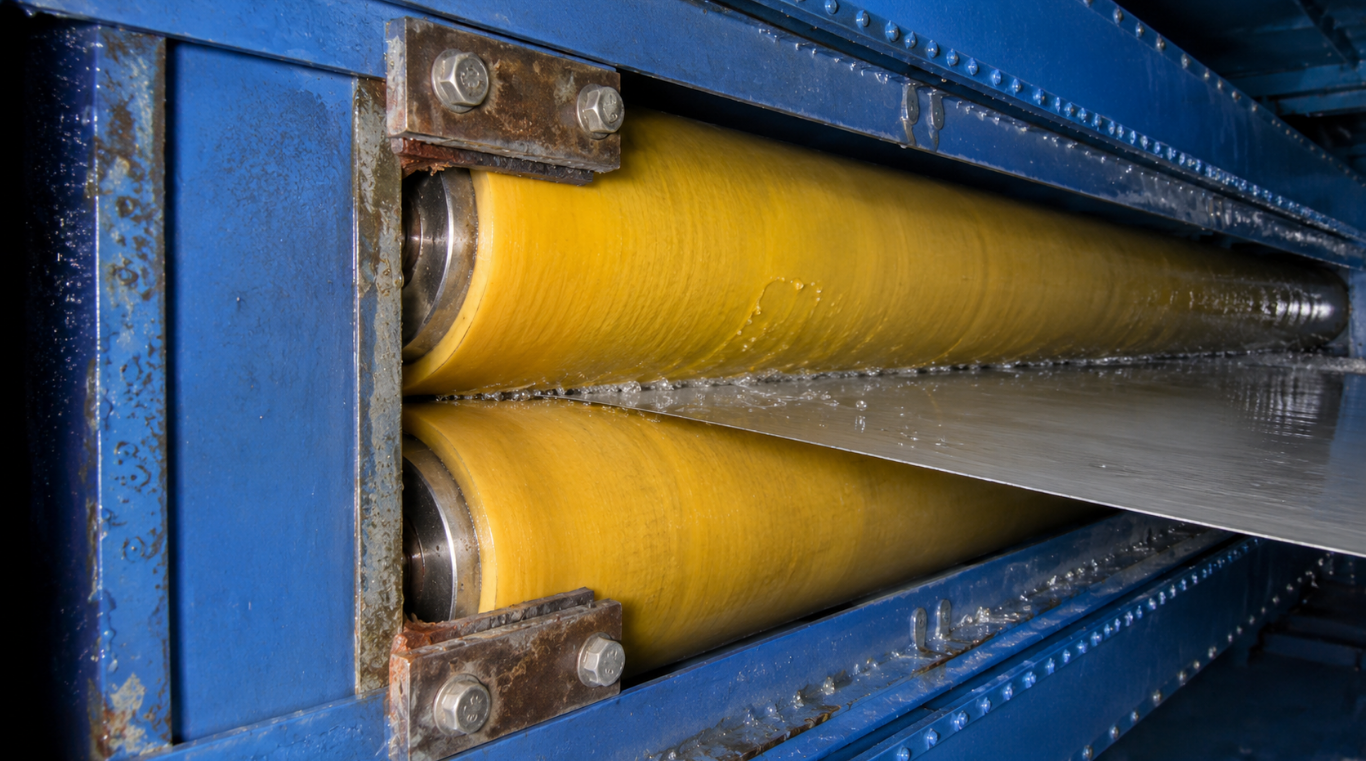
Liquid left on steel strip travels into the next process stage. Cleaning solution can contaminate a downstream rinse, excess water increases drying demand, and uneven rolling-oil residue complicates control of the outgoing surface.
Nonwoven rolls use a compressible, porous working surface to control this liquid film. Selection starts with the roll position and required outlet condition.
Rinsing After Pickling
On pickling and stainless steel annealing-and-pickling lines, wringer rolls can reduce liquid transfer between rinse stages and residual water before drying. A roll at an acid-bath exit encounters different conditions from one after the final rinse.
Specify the actual chemicals, concentrations, temperatures, and possible upstream carryover. Ask the supplier to confirm the proposed cover grade for those conditions. A pH value alone does not establish compatibility. [NCCM’s chemical-roll guidance](https://nccmco.com/pages/NCCM_CXseries.html) distinguishes grades for chemically demanding duties and calls for checking the specific solution.
These are wet-processing positions. Suitability for an annealing-and-pickling line does not establish suitability for transport inside its furnace.
Cleaning Before Annealing or Galvanizing
Lines using wet precleaning need separate control of cleanliness and residual moisture. Degreasing removes contamination, rinsing removes cleaning solution, and wringing reduces the liquid reaching the dryer.
The background description in an [SMS strip-cleaning patent](https://patents.google.com/patent/US20080210256A1/en) includes rinse stages separated by squeezing rolls, followed by edge blow-off and drying.
If oil or iron fines remain, investigate cleaning performance. If cleanliness meets specification but the strip remains wet, inspect wringing and drying. A visually dry surface does not prove that cleaning was effective, and a wringer cannot replace the complete cleaning sequence.
Removing Excess Oil After Cold Rolling
[Wöhler’s application guidance](https://tb.woehler.com/en/non-woven-roll-application/) identifies squeezing oil and emulsions from cold-rolled strip as a nonwoven-roll application.
State whether the liquid is neat rolling oil or an emulsion, then define the acceptable residue. Mechanical de-oiling does not guarantee a fully degreased surface. Where subsequent processing demands greater cleanliness, additional cleaning remains necessary.
Record fluid temperature, viscosity or emulsion concentration, and line speed during trials. Compare replacement and existing rolls under similar conditions. A satisfactory low-speed test does not demonstrate performance at normal production speed.
Investigating Uneven Wringing
The location of residual liquid helps narrow the investigation:
– A wet center with drier edges warrants checking shaft deflection, roll profile, and contact uniformity. Increasing pressure may worsen the imbalance.
– Wet strip edges warrant checking edge contact, strip thickness, and cover damage. Softer material may improve conformity but must also withstand the strip edge.
– Increased carryover after acceleration requires reviewing performance at that speed and the incoming liquid conditions.
These are diagnostic leads, not conclusions from appearance alone. [NCCM’s wringer-roll white paper](https://www.nccmco.com/pdf/Design%20and%20Operate%20Wringer%20Rolls_PDF.pdf) discusses these pressure, contact, and speed effects. Adjustments must remain within equipment and roll limits.
Approving a Replacement Roll
Agree on acceptance criteria before installation. During a controlled trial, compare residual liquid across the strip width, inspect for new marks or contamination, and record any cleaning, adjustment, or downtime required.
Test representative strip widths at normal operating speeds. Keep fluid conditions and sampling locations consistent, and record deviations.
Use agreed measurement methods: residual oil may be assessed as mass per unit area, while moisture needs a validated plant method. Check edges and center separately, and both surfaces where required. Sample only through approved safe procedures.
An initial trial confirms performance; service life needs longer records. For cost comparisons, track purchase, maintenance, and roll-change downtime costs against accepted tonnes processed over a comparable period.
For custom [nonwoven mill rolls](https://brushcustom.com/products/nonwoven-mill-rolls/), a dimensioned drawing, roll position, process fluid, operating conditions, and outlet acceptance requirements provide the basis for technical review. After approval, retain the material specification and drawing revision for repeat orders.
Article received via email