Axelspace Corporation, Meisei Electric Co., Ltd., ANA HOLDINGS INC., and JIJ Inc. today announced their jointly proposed technology development project has been selected for Japan Aerospace Exploration Agency (JAXA)’s Space Strategy Fund under the theme “Technology to Enhance Capability of Next Generation Earth Observation Satellites.”
Project Summary (Planned)
Technology Development Theme: Technology to Enhance Capability of Next Generation Earth Observation Satellites
Project Title: Source-Specific CO2 Emission and Uptake Monitoring through Satellite Constellation and Aircraft Observations
Lead Organization: Axelspace Corporation
Partner Organizations:
– Meisei Electric Co., Ltd.
– ANA HOLDINGS INC.
– JIJ Inc.
Funding Opportunity: JAXA Space Strategy Fund
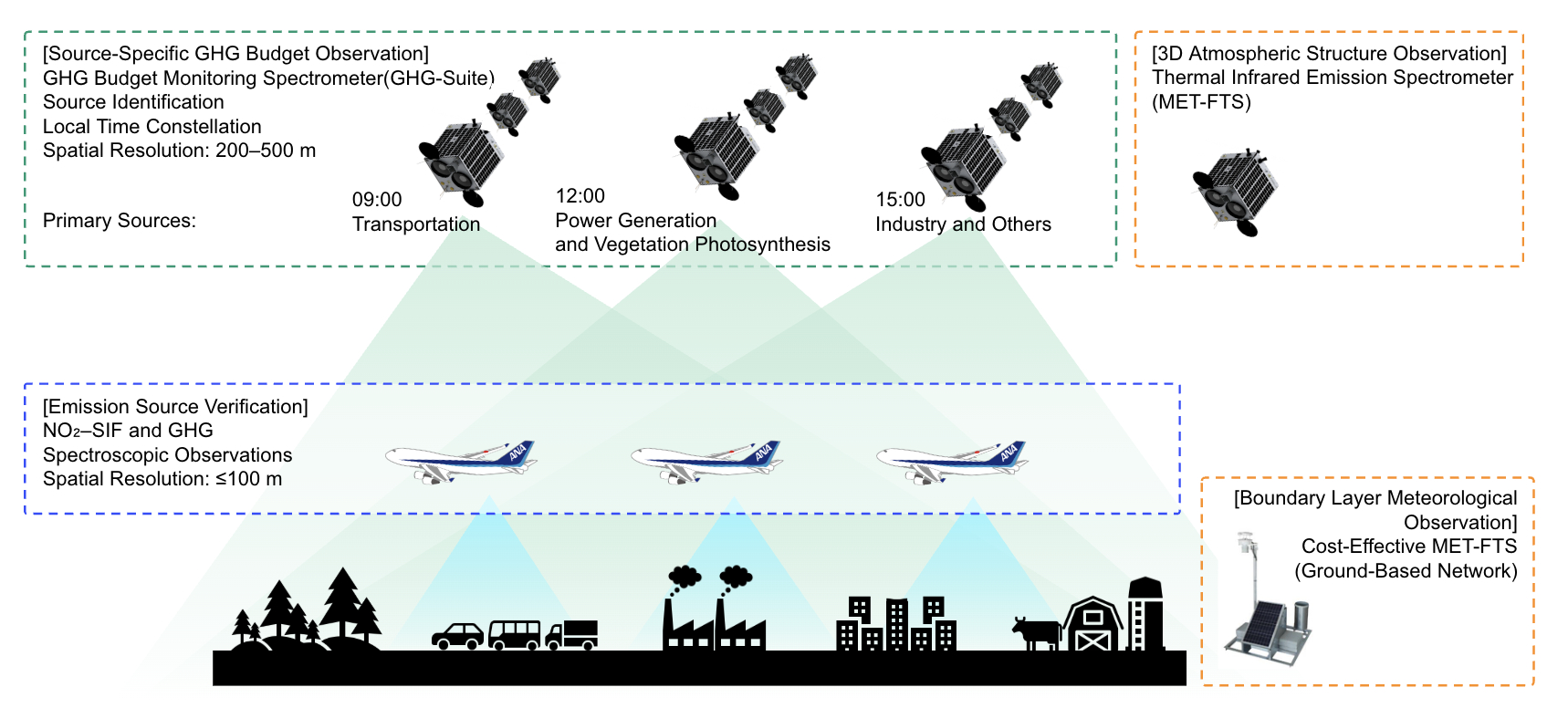
We envision establishing a new satellite constellation in coordination with aircraft and ground-based sensors upon completion of this technology development. This integrated system aims simultaneous, multi-point observations at different times of day — morning, noon, and afternoon — particularly in regions that house major urban areas. Leveraging these data, we will analyze and provide CO2 emission and uptake information by source sector, time, and location.

We believe that such objective and transparent information should provide a basis for an international benchmark for GHG reductions and contribute to the development of globally harmonized evaluation frameworks that incorporate economic incentives for emissions mitigation.
Technology Development Plan
A key enabler for achieving time- and source-specific CO2 monitoring through a coordinated satellite constellation, aircraft, and ground-based observations is the miniaturization and cost reduction of spectrometers.
Spectrometers measure gas concentrations by leveraging the property that atmospheric constituents absorb light at specific wavelengths, quantifying concentrations based on the degree of absorption. Under this Space Strategy Fund initiative, we will develop a new compact sensor that can be commonly deployed across satellites, aircraft, and ground-based observations. Unlike conventional high-precision spectrometers designed for government-operated satellites — which are typically large and costly — the new sensor will incorporate advanced domestically developed detector technologies to achieve both compactness and affordability.
Following a series of aircraft-based validation tests, we plan to launch a demonstration satellite equipped with the newly developed compact sensor between FY2030 and FY2032, with the aim of acquiring in-orbit observation data.