Email signatures are one of those problems that look trivial until you actually try to control them across an organization. Anyone can paste a nice-looking block into their own Outlook. Getting several hundred people to use the same one – correct logo, current job titles, the right legal disclaimer, and identical formatting whether they’re on a laptop or a phone – is a genuinely hard IT problem, and the all-staff email asking everyone to “please update your signature” has never once solved it.
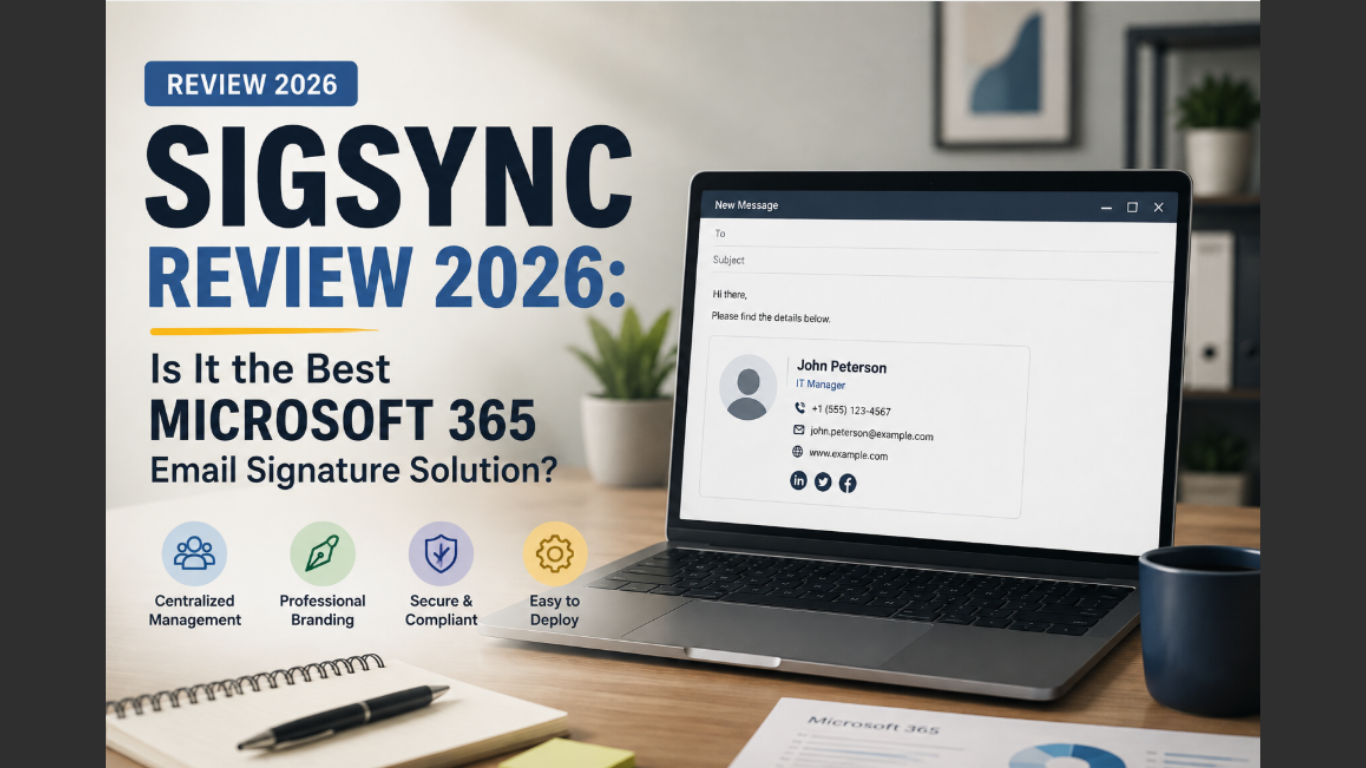
Sigsync is a dedicated signature-management platform built specifically for Microsoft 365, and it sets out to solve exactly that. I spent time putting it through its paces to answer a simple question: is it actually the best option in this category, or just another tool? This review covers what it does, how it works, where it’s strong, and the caveats worth knowing. As always, the free trial is the real test, but here is what I found.
Sigsync Review: Key Features at a Glance
If you’re pressed for time, here is the short version before the detail.
| Category | Rating | Quick take |
| Coverage | Excellent | Consistent signatures on every device and mail client, including mobile |
| Flexibility | Excellent | Three deployment modes; rules, targeting, and dynamic fields |
| Ease of use | Very good | Drag-and-drop editor, no HTML skills required |
| Security & compliance | Excellent | SOC 2 Type 2, ISO 27001, OAuth 2.0, TLS, GDPR & HIPAA aligned |
| Marketing features | Very good | Scheduled banners, social icons, campaign management |
| Support | Excellent | 24/7 support included free with every plan |
| Value | Excellent | Less than $1/user, up to 70% discounts, 14-day no-card trial |
What Is Sigsync?
Sigsync is a cloud-based, email signature for Office 365 that lets you design, manage, and enforce signatures for an entire organization from a single web dashboard. Rather than depending on each user to install or maintain anything, it applies the correct signature automatically, so what leaves your organization is consistent, on-brand, and compliant regardless of who sent it or from what device. It’s a Microsoft-approved solution listed on Microsoft AppSource, which is a reasonable signal of trust in a category where you’re handing a vendor a degree of access to your outbound mail.
How Signatures Are Applied: Three Deployment Modes
The single most important thing to understand about any signature tool is where the signature gets added, because that determines how reliably it works. Sigsync offers three modes, and the flexibility to choose is one of its genuine strengths:
- Centralized (Recommanded). The mode I’d point most organizations to. It enforces signatures across every platform for guaranteed consistency, while still letting users preview or switch to an approved alternative as they write – the best balance of admin control and a normal experience for staff.
- Server-side. Outbound mail is routed through the Sigsync Azure service, which stamps the signature after the message has left the user. This gives you total coverage across every device and client, since the signature is added downstream of whatever the person used to send it. Server-side routing may require updating your SPF configuration depending on your existing mail flow.
- Client-side. The signature is inserted directly inside Outlook – on Windows, Mac, web, iOS, and Android – as the user composes. Because it happens locally, users can see the signature while writing and pick between approved alternatives, and nothing routes externally. Its reach is tied to the Outlook add-in being deployed.
Why Manual Email Signatures Fail at Scale
Before judging any signature tool, it helps to be honest about why the do-it-yourself approach breaks down, because that is the problem Sigsync is really being measured against. On paper, asking staff to paste an approved signature into Outlook seems simple enough. In practice, four things go wrong, and they compound.
- Enforcement is optional. If applying the signature depends on each employee doing it correctly, you don’t have a standard – you have a suggestion. Some paste it wrong, some edit it, some ignore it, and new starters copy whoever sits next to them.
- It drifts immediately. Even perfect compliance on day one decays fast. People change titles, numbers, and offices; the company rebrands; a new disclaimer is required. Each change means another all-staff email and another round of partial compliance.
- Devices fragment it. A signature pasted into desktop Outlook doesn’t follow the user to Outlook on the web or to their phone, where the device appends its own default text instead. Your most diligent people still send unbranded email from a train.
Once you frame it that way, the conclusion is unavoidable: signatures have to be applied by a system, not by people. That is the bar Sigsync has to clear, and it is worth keeping in mind through the rest of this review.
Designing Signatures Without Touching HTML
One of Sigsync’s biggest strengths is that marketing – not IT – can manage email signatures. Its drag-and-drop editor requires no HTML knowledge, making it easy to update layouts, fonts, colours, images, and logos. Ready-made templates, social media icons, promotional banners, and scheduled banner campaigns let marketing run time-based promotions without IT involvement. It also supports vCards with QR codes for quick contact sharing. These features make ongoing signature management simple while keeping IT out of routine updates.
Security and Compliance
Anything that touches outbound mail flow gets scrutinized, and this is an area where Sigsync is genuinely strong rather than adequate. It follows Microsoft’s email-flow guidelines and processes mail through Microsoft Azure, authenticates with OAuth 2.0, and uses TLS encryption. On the compliance side it is SOC 2 Type 2 certified and ISO 27001 certified, with GDPR and HIPAA alignment – the independent audits that carry weight in a security review precisely because they aren’t self-assessed. For regulated organizations, the ability to enforce a legal disclaimer on genuinely every outbound message, regardless of device, is the entire point, and having it apply to shared mailboxes and appear in Sent Items closes the gaps that trip up manual approaches.
Setup and Pricing
Setup is quicker than I expected. A 14-day free trial is available with no credit card, so you can validate the whole approach before any budget conversation. The sequence is straightforward: sign in to the dashboard, register and configure your Microsoft 365 tenant, build your templates, set the rules that decide who gets what, and – for centralized and server modes – add an SPF record to your domain. That SPF step is the one to plan for, since it’s a DNS change involving whoever owns that in your organization; everything else took an afternoon.
On the commercial side, the details are refreshingly simple:
- Pricing -Sigsync starts at approximately $0.72 per user/month for 100-user licenses, with flexible monthly and annual subscription options. Larger license purchases receive higher volume discounts, making it a cost-effective solution for organizations of all sizes.
- Free trial – 14 days, no credit card required.
- Support – 24/7, included free with every plan.
- Platform – built for Microsoft 365 .
For a function that touches every outbound email in the business, that pricing is easy to defend, and bundling 24/7 support at no extra cost is not something every vendor in this space does.
Benefits and Drawbacks of Sigsync
No tool is perfect, and after working through the platform I came away with a clear view of where it shines and where you’ll need to plan around its limits. The table below lays out the trade-offs honestly – none of the drawbacks were dealbreakers, but they’re better known upfront than discovered mid-rollout.
| Benefits | Drawbacks |
| Enforced, consistent signatures on every device and mail client, including mobile | Built Specially for Microsoft 365 / Exchange. |
| Three deployment modes to match your control and coverage needs | Server mode require an SPF record (a DNS change to plan) |
| Dynamic Azure AD fields keep signatures accurate with zero manual editing | Designing a good rule set takes some upfront thought |
| Strong compliance posture – SOC 2 Type 2, ISO 27001, GDPR, HIPAA | |
| Drag-and-drop editor, scheduled banners, and 24/7 free support |
The Verdict
Sigsync makes a compelling case as one of the best email signature solutions for Microsoft 365 and Exchange. Its three deployment modes, dynamic Azure AD integration, and strong security certifications (SOC 2 Type 2 and ISO 27001) simplify signature management while meeting enterprise compliance needs. Combined with a drag-and-drop editor, marketing banner support, 24/7 free support, and pricing under $1 per user, it offers excellent value. The only limitation is its Microsoft-only focus, making it unsuitable for Google Workspace. If your organization uses Microsoft 365, Sigsync deserves a place at the top of your shortlist.
Article received via email