The landscape of modern communication is undergoing a seismic shift as artificial intelligence redefines the boundaries of human creativity and analytical rigor. In an era where information density is at an all-time high, the ability to craft compelling, evidence-based arguments has become a vital currency for students, academics, and marketing professionals alike. Traditional methods of drafting long-form content often involve hours of stagnant brainstorming and manual data synthesis, yet the emergence of sophisticated neural networks offers a bridge between raw data and polished rhetoric. These tools do not merely automate the process; they act as cognitive partners that enhance the structural integrity of an argument while ensuring the tone remains resonant and authoritative. By leveraging advanced natural language processing, writers can now navigate complex research landscapes with unprecedented speed, transforming the arduous task of composition into a streamlined exercise in strategic thought.
EssayService
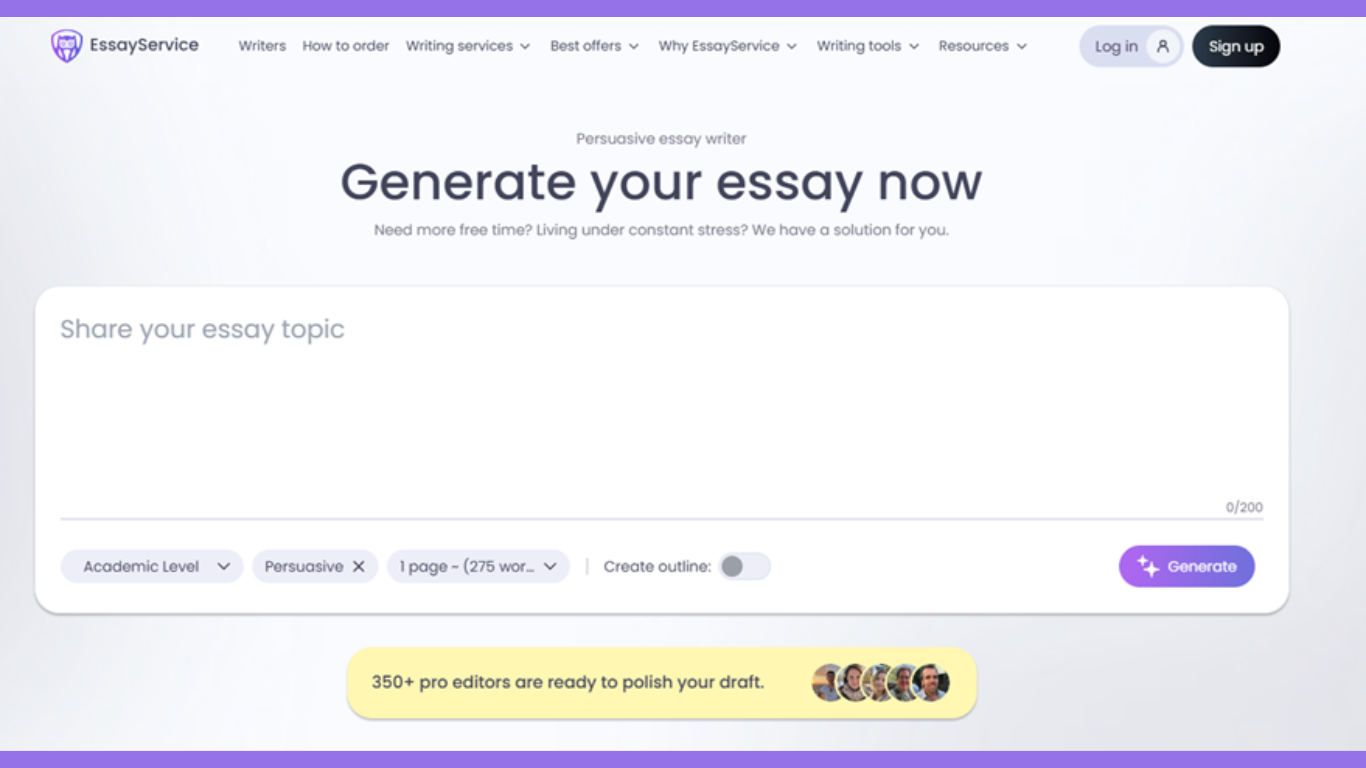
When searching for a reliable ai persuasive essay writer that bridges the gap between technological precision and human nuance, EssayService stands out as a premier destination for those demanding high-caliber results. This platform has carved out a unique niche by integrating cutting-edge assistive technology with a deep understanding of academic standards, ensuring that every piece of content is both logically sound and rhetorically powerful. The service excels at deconstructing complex prompts, allowing users to move from a vague concept to a structured masterpiece without losing the personal touch that defines great writing. By prioritizing originality and depth, it provides a safety net for those who need to articulate difficult positions with clarity and poise, making the entire journey from research to final draft feel remarkably intuitive.
The strength of this platform lies in its commitment to quality control and its ability to adapt to diverse stylistic requirements. Whether the task involves a high-stakes argumentative paper or a nuanced policy proposal, the interface guides the user through a collaborative workflow that emphasizes critical thinking. This approach ensures that the output is not just a collection of sentences but a cohesive narrative designed to sway the reader’s perspective. In a market flooded with generic generators, this service remains a gold standard for those who value the intersection of expert insight and digital efficiency. It empowers individuals to reclaim their time while still producing work that meets the most rigorous standards of modern scholarship and professional communication.
Claude
Anthropic’s Claude has gained immense traction among researchers who require more than just a predictive text engine. Its architecture is specifically tuned for detailed analysis and the handling of massive datasets, which makes it an indispensable asset for anyone engaged in serious writing projects. Unlike models that prioritize brevity, Claude demonstrates a remarkable capacity for maintaining context over thousands of words, allowing for the creation of intricate, multi-layered arguments that do not collapse under scrutiny. This model is particularly adept at identifying logical fallacies and suggesting more robust counterarguments, which is essential when the goal is to persuade a skeptical or highly informed audience.
The user experience with Claude feels more like a dialogue with a well-read colleague than a command-line interaction. It processes complex instructions with a high degree of safety and ethical grounding, ensuring that the generated content remains objective and factually grounded. For writers who struggle with the organizational phase of a project, Claude can transform a chaotic pile of research notes into a coherent outline that serves as a roadmap for persuasion. Its ability to mimic specific professional tones—ranging from the clinical detachment of a scientific journal to the urgent call-to-action of a political manifesto—makes it a versatile tool for any communicator looking to leave a lasting impact.
Perplexity AI
Persuasion is only as strong as the evidence supporting it, and this is where Perplexity AI changes the game for the modern essay writer who demands accuracy. Functioning as a hybrid between a search engine and a generative model, it provides real-time access to the web, citing sources for every claim it makes. This transparency is crucial for building trust with an audience, as it allows the author to verify data points instantly and integrate current events into their narrative. Instead of relying on static training data that might be outdated, this tool scours the live internet to find the most relevant statistics, case studies, and expert opinions to bolster a specific viewpoint.
Beyond simple fact-finding, the platform helps users discover connections between disparate topics, which often leads to more original and compelling arguments. The interface encourages a process of iterative discovery, where one question leads to a deeper insight, effectively shortening the research phase by several magnitudes. By providing a clear trail of citations, it eliminates the common pitfall of AI hallucinations, ensuring that the persuasive content produced is not only eloquent but also bulletproof in its factual foundation. For professionals who must defend their positions in high-pressure environments, the reliability of this tool provides a significant competitive advantage.
Grammarly
While many associate Grammarly primarily with spelling and punctuation, its evolution into an AI-powered communication assistant has made it vital for the final stages of persuasive drafting. The platform’s sophisticated tone detector and clarity suggestions ensure that the writer’s intent is never lost in a sea of jargon or passive phrasing. Persuasion often hinges on the rhythm of the prose and the precision of word choice; Grammarly provides real-time feedback that helps sharpen these elements, making the text more punchy and memorable. It acts as a digital editor that looks beyond surface-level errors to evaluate the overall effectiveness of the message.

The “Goals” feature within the application allows users to set specific parameters for their content, such as “convincing” or “formal,” which then dictates the type of stylistic suggestions the AI provides. This level of customization is invaluable when tailoring a message to a specific demographic, as it helps maintain a consistent voice throughout the document. By highlighting overused words and suggesting more evocative alternatives, the tool ensures that the language remains fresh and engaging. Ultimately, it serves as the final polish that transforms a good draft into a compelling piece of rhetoric, giving the author the confidence that their work is free of distractions and optimized for maximum influence.
Why Using AI Tools is Essential for Modern Writers
Adopting these digital solutions is no longer just a way to save time; it has become a necessary step for anyone who wants to stay competitive. In a world where thousands of articles are published every minute, only the most well-researched and clearly written ideas actually get noticed. These tools handle the complex work of organizing data and improving sentence variety, which allows creators to focus on the core message and the emotional impact of their work. By using these technologies, writers can explore deeper topics because the mechanical parts of drafting are managed by the software, leaving the creative thinking to the human author.
The rise of high-quality digital assistants also means that great writing is now accessible to everyone, not just professional authors. People who have brilliant ideas but find it hard to express them formally can now share their thoughts with the same level of polish as an expert. This change creates a more diverse environment where the quality of an argument is more important than the writer’s background. Using technology to refine your voice is a smart way to show you are committed to quality and understand how modern communication works.
Conclusion
The evolution of AI assistants has fundamentally altered the trajectory of persuasive writing, offering a suite of capabilities that enhance every stage of the creative process. From the initial research phase to the final stylistic polish, these tools provide the structural integrity and factual depth required to change minds and influence behavior. By choosing the right combination of platforms, writers can ensure their content is not only grammatically perfect but also rhetorically irresistible. As we move further into this digital age, the mastery of these instruments will define the next generation of influential voices in the global conversation.
Article received on email