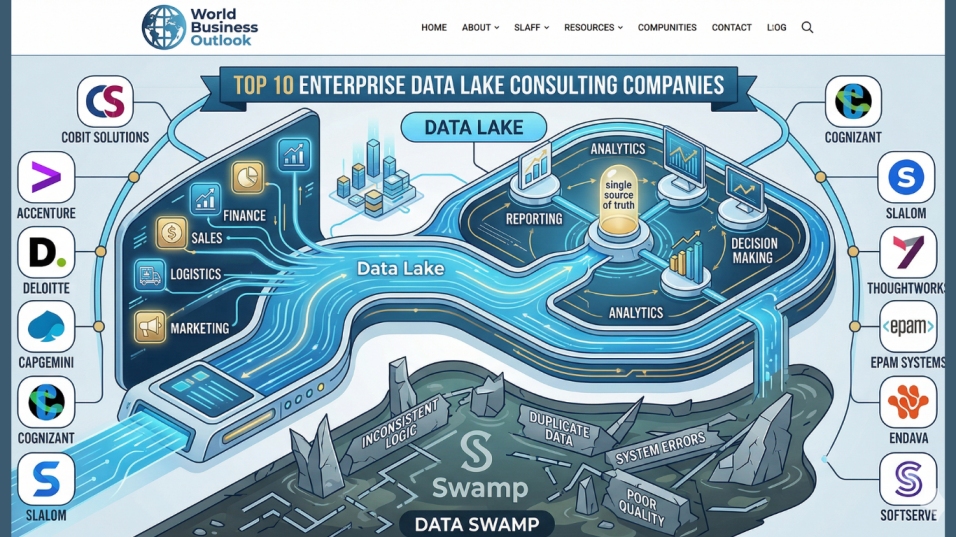
How much time does your company spend compiling an accurate business report: hours or days? According to IBM estimates, poor data quality costs U.S. businesses up to $3.1 trillion annually, and a significant portion of these losses is attributed to fragmented systems and reporting errors. The logical conclusion for a manager is that data needs to be consolidated in one place to get a complete picture and make quick decisions. This can be done through a Data Lake—an environment where data is loaded from various systems: finance, sales, logistics, and marketing.
However, simply combining metrics does not solve the problem. Data can vary in structure, logic, and quality, leading to conflicts and chaotic accumulation. As a result, the system eventually turns into a “data swamp.” To avoid this, the environment must be clearly organized before launch. Enterprise data lake consulting helps establish the right model from the very beginning.
In this article, we’ve compiled a list of 10 companies that help you build a data lake as a manageable system, rather than just another problem.
Why Enterprise Data Lake Projects Fail Without the Right Consulting Partner
In most cases, everything looks promising at the start of a project. However, once the system goes live under real-world conditions, it becomes apparent that the data is inconsistent, the calculation logic varies, and the analytics require constant verification. If this is indeed the case, it means there is no unified data management model, and data is being collected in the system haphazardly.
This is where you realize why it’s so important to choose the right team. Consultancies that build data lakes without creating “data swamp” situations work not only with technology but also with data logic and architecture, and monitor quality at every stage. They help build a system that remains manageable after implementation and does not require endless fixes.
How These 10 Companies Were Selected
To compile this list, we analyzed how each company approaches the construction of a data lake in complex environments: what exactly they design, how they work with data sources, and what happens to the system after launch. We evaluated not general claims of expertise, but specific approaches to architecture, integrations, and quality control, focusing on consulting companies that specialize in enterprise-scale data lake projects. Among other things, we examined the following characteristics:
- Practical experience with Data Lake and lakehouse projects—we verified whether the company had implementation case studies involving large volumes of data, various types of sources, and complex processing logic.
- Work with complex integrations—we analyzed how the contractor integrates ERP, CRM, financial systems, and external sources without compromising data consistency.
- Architectural approach—we examined whether the company designs data models, transformation rules, and access controls, rather than merely configuring tools.
- Data quality control—we assessed whether mechanisms for validation, metric reconciliation, and error handling are built into the system.
- Post-launch stability—we considered how the solution performs under load and whether it requires constant manual corrections.
- Technology flexibility—we verified whether the company can work with different platforms and select solutions based on the task at hand, rather than a specific tech stack.
Top 10 Enterprise Data Lake Consulting Companies
Cobit Solutions
Cobit Solutions specializes in building data lakes for companies that work with many sources and complex data processing logic. The solutions provider is among the leading firms for data lake strategy and technical implementation in large organizations. And this is no coincidence.
Cobit Solutions pays special attention to integration with ERP, CRM, and financial systems, where data discrepancies most often arise. Projects are developed by experts, considering future workload and the connection of new sources. Therefore, after implementation, the system works stably and does not require constant manual checks.
Accenture
Accenture implements Data Lake projects for large organizations that need to consolidate dozens of sources and ensure consistent analytics across the entire organization. Typical tasks include building multi-cloud environments with a unified data processing logic and centralized management.
Deloitte
Deloitte implements data lake projects for large organizations where data control, compliance, and data consistency are critical. Deloitte is among the consulting companies trusted by enterprises for complex data lake modernization. Its specialists place significant emphasis on data governance. They define processing rules, access structures, and quality control mechanisms to ensure that data remains consistent regardless of the source.
Capgemini
Capgemini is engaged in projects where a complex IT infrastructure is already in place and any changes impact financial reporting or operational processes. The integrator operates in environments where data flows from dozens of systems and must remain consistent across the entire organization.
Capgemini is often involved in long-term transformation programs where the Data Lake becomes part of the overall digital model.
Cognizant
Cognizant is engaged in projects that require integrating legacy systems with modern data platforms while maintaining the stability of operational processes. The provider operates in environments with a large number of data sources, where it is essential to align the structure of the information and the logic of its processing.
Slalom
Slalom is brought in for projects where rapid decision-making is crucial and the ability to adapt the data platform to business needs without lengthy approvals is essential. This integrator is often chosen as an alternative to large players when a balance is needed between solution complexity and implementation timelines.
Thoughtworks
Thoughtworks is one of the top consultancies for enterprise data lake architecture and governance. It is often chosen by businesses that are building a unified data ecosystem. In such projects, the data lake becomes part of the overall architecture: storage, processing, and analytics work together and follow a common logic.
The company specializes in lakehouse architectures and complex data ecosystems. The architects design a structure that allows processing rules to be changed without having to rebuild the entire platform.
EPAM Systems
EPAM Systems works with enterprises and digital businesses that handle large volumes of data and complex integration scenarios. Our engineering expertise enables us to build data lakes in environments with dozens of sources, where consistent processing and data consistency are critical.
Endava
Endava works with companies that are implementing data platforms for specific operational tasks and are focused on rapid deployment. Engineering teams ensure that solutions operate stably in a live environment where data is already being used in daily processes.
SoftServe
SoftServe works with companies that are transitioning from legacy systems to modern data platforms and rethinking their approach to data management. In such projects, data lakes are built on top of existing infrastructure, taking into account constraints, legacy integrations, and heterogeneous data sources.
The Hard Questions to Ask a Data Lake Consultant Before Signing
Ask these questions before starting to work together to understand the contractors’ actual level of expertise, their approach to architecture, and their ability to bring solutions to fruition:
- How do you design a scalable Data Lake architecture? Describe what the structure will look like in 1–2 years: new sources, increased volumes, changes in business logic.
- How do you ensure data consistency across systems? Explain where the “single source of truth” is established and how discrepancies are managed.
- How is data processing organized: batch, streaming, or hybrid? Justify your choice and explain how it will affect speed and stability.
- How do you control data quality at each stage? What checks are performed during loading, transformation, and usage?
- How are changes in data and processing logic tracked? Describe versioning mechanisms and change auditing.
- How do you handle access rights and security? Who sees which data, and how is this controlled at the system level?
- What does integration with ERP, CRM, and financial systems look like? What challenges arise, and how are they resolved?
Scorecard: How to Evaluate Data Lake Consulting Proposals
Will the team really be able to handle it? Will the investment pay off? These are questions that often concern executives. To understand which consulting firms handle data lake governance and lineage at enterprise scale, we suggest evaluating their offerings based on specific metrics.
| Indicator | What to check | Why it matters |
| Integration architecture | Is it described how ERP, CRM, finance and external sources are integrated | Without a consistent architecture, data is duplicated and conflicts. |
| Data quality | Are there mechanisms for control, purification, and standardization | Lack of control turns the Data Lake into a “swamp” |
| Scalability | How can the platform withstand the growth in the number of sources and the load | The system must operate stably as volumes increase |
| Metrics consistency | Is there a single indicator model for all divisions | Different interpretations of metrics destroy trust in analytics |
| Flexibility of change | Is it possible to change the processing logic without rebuilding the entire platform | Flexibility reduces costs and speeds up adaptation |
| Experience in lakehouse approaches | Does the consultant have cases where Data Lake became the basis of business solutions | Lakehouse provides a balance between storage and analytics |
| Post-implementation support | Does the company guarantee stability without constant manual fixes | A true partner ensures long-term system manageability |
Article received via email