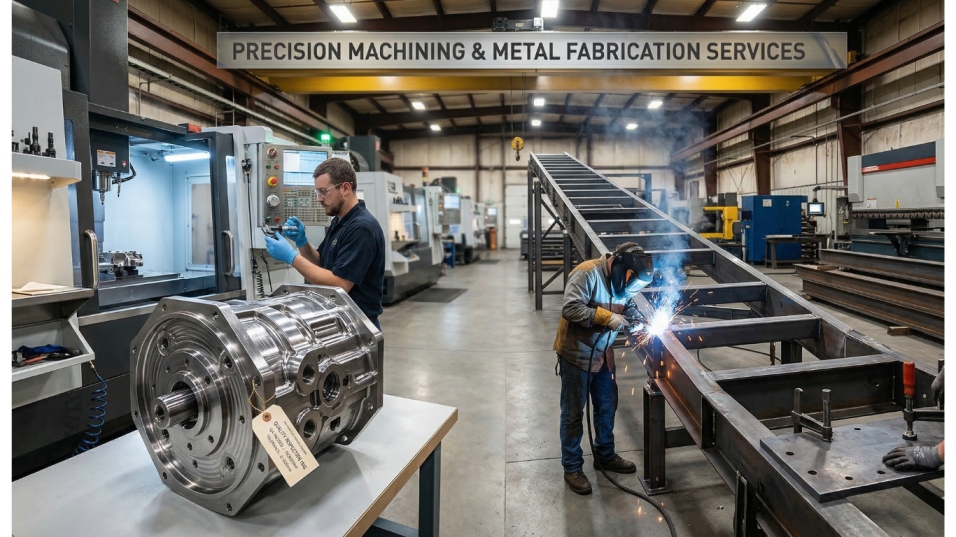
Precision machining and metal fabrication are vital processes in contemporary manufacturing, allowing industries to produce components and structures with remarkable accuracy, durability, and efficiency.
Companies like CT Products, a dependable provider of Machine and Fabrication Shop Services, specialize in delivering high-quality precision parts and components. By utilizing advanced equipment and techniques, they offer reliable solutions for a variety of industrial applications including industrial manufacturing, mining, steel production, warehousing and conveyor systems, oil and energy, heavy equipment, and aerospace. Their expertise ensures that industries can depend on durable, accurate, and precise components for critical operations.
What Is Precision Machining?
Precision machining is a manufacturing method that involves removing material from a workpiece to achieve a specific shape, size, and tolerance.
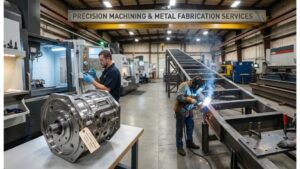
This process relies on highly controlled equipment such as CNC (Computer Numerical Control) machines, lathes, milling machines, and grinding tools, allowing manufacturers to produce parts with exceptional accuracy. Precision machining is particularly important in industries where even minor deviations can impact performance, safety, or reliability.
Key aspects of precision machining include:
- Tight tolerances: Parts are manufactured to precise dimensions, ensuring proper fit and function.
- Consistency: High-volume production maintains uniformity across all components.
- Material versatility: Metals, plastics, and composite materials can be machined according to specific project needs.
- Complex geometries: Advanced CNC machines enable intricate designs that would be difficult or impossible to achieve with manual methods.
Industries such as aerospace, heavy equipment, and oil and energy heavily depend on precision machining to maintain equipment performance, ensure operational safety, and extend the lifespan of critical components.
Understanding Metal Fabrication
Metal fabrication is the process of transforming raw metal materials into finished products or components through cutting, bending, welding, and assembling.
Unlike machining, which primarily removes material, fabrication focuses on reshaping and joining metals to create functional structures. Fabrication is crucial for creating frameworks, assemblies, and structures that are strong, durable, and tailored to meet operational needs.
Common metal fabrication processes include:
- Cutting: Metals are shaped using laser, plasma, or waterjet cutting tools.
- Bending and forming: Sheets or plates are reshaped into angles, curves, or custom geometries.
- Welding and joining: Separate components are fused to create strong, seamless structures.
- Assembly: Fabricated parts are combined to produce final products or industrial frameworks.
Metal fabrication serves a wide range of applications such as conveyor systems, steel frameworks, industrial machinery, and oil and energy infrastructure. Proper fabrication ensures that structures maintain their strength and functionality while meeting specific design and performance requirements.
Combining Precision Machining and Metal Fabrication
For many industrial projects, integrating precision machining and metal fabrication provides the best results. This combination allows manufacturers to produce complex components with exact dimensions while maintaining structural integrity.
- Improved accuracy and performance: Machined components fit precisely with fabricated structures.
- Efficiency in production: Combining processes reduces assembly time and material waste.
- Versatility in design: Complex and large-scale structures can incorporate precise machined elements.
For example, conveyor systems often depend on fabricated metal frames with precision-machined gears, rollers, and brackets to ensure smooth, reliable operation. Aerospace components frequently use both processes to meet safety-critical requirements while maintaining structural strength and reducing weight.
Factors in Choosing Machine and Fabrication Shop Services
Selecting the right provider for Machine and Fabrication Shop Services is essential for ensuring accuracy, reliability, and quality.
Reputable machine shops employ advanced machinery, skilled technicians, and strict quality control protocols to deliver components that meet rigorous industrial standards.
Key considerations include:
- Equipment capabilities: Advanced CNC machines, automated welding systems, and precision cutting tools enable complex projects.
- Industry experience: Providers familiar with industrial, mining, oil and energy, and aerospace standards can ensure proper material selection and manufacturing techniques.
- Quality assurance processes: Inspections, testing, and documentation maintain component tolerance, strength, and longevity.
- Project management: Timely delivery, technical guidance, and collaboration improve workflow and efficiency.
Relying on experienced providers allows industries to minimize errors, reduce downtime, and maintain consistent production quality, which is especially critical for mission-critical applications such as heavy machinery, steel production, and aerospace systems.
Conclusion
Precision machining and metal fabrication are foundational elements of modern industrial manufacturing, providing the accuracy, durability, and efficiency required for complex applications.
Through processes like CNC machining, cutting, bending, welding, and assembly, manufacturers can produce components and structures that meet stringent operational requirements. Companies offering comprehensive Machine and Fabrication Shop Services support industries such as industrial manufacturing, mining, steel production, warehousing, oil and energy, heavy equipment, and aerospace by providing reliable, precise, and long-lasting solutions. By understanding and utilizing these processes, industries can achieve consistent quality, reduce production errors, and ensure the optimal performance of their equipment and infrastructure.
Article received on email