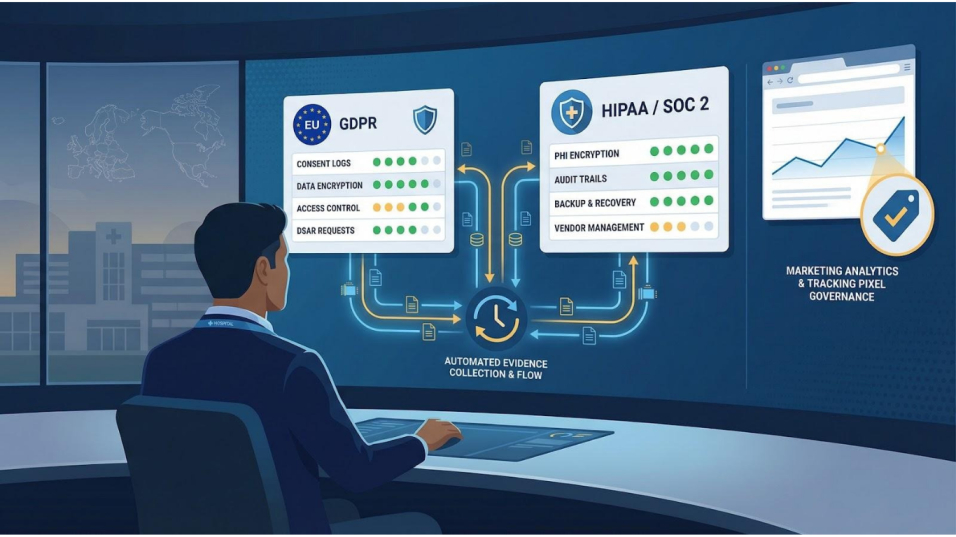
Regulators on both sides of the Atlantic are turning up the heat. Hospitals in Europe now face multimillion-euro GDPR fines for a single tracking pixel, and the U.S. Office for Civil Rights warns that routine analytics can expose protected health information. The message is clear: following one rule no longer shields you from the other.
We’re writing for the people caught in that squeeze—CISOs at hospital groups, privacy officers at tele-health start-ups, and IT leads who wear “security” and “legal” on the same lanyard. Grab a coffee; let’s find the platform that lets you stop firefighting spreadsheets and get back to patient care.
How we ranked the tools
Before we crown any winner, we need a fair fight. We built a scoring model that mirrors the headaches you face every audit cycle: “Do we hit both frameworks, and will the software do the chasing for us?”
A platform had to offer native mappings for both HIPAA and GDPR, show proof of healthcare use (a hospital case study or a signed BAA), and ship product updates after January 2024. Anything less stayed on the bench.
We then graded the survivors across five factors. Dual-framework coverage and automation depth carry double weight, because missing a control—or spotting it too late—is what costs real money. Privacy features, healthcare adoption, and cost transparency round out the rubric.
1. Vanta: continuous compliance on autopilot
In a 2026 overview of the leading GRC software options, Vanta highlights how modern platforms keep a control matrix breathing on its own. Plug it into AWS, Okta, GitHub, and the usual hospital stack, and the platform starts pulling evidence every few minutes. Encryption status, user-access logs, and backup checks all flow into one dashboard where you can show an auditor without opening a screenshot tool.
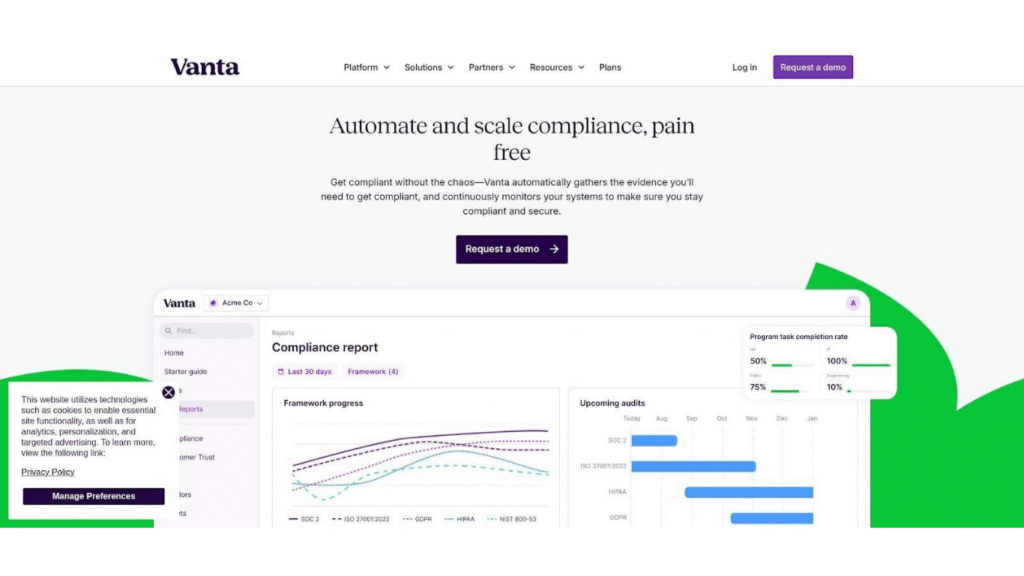
Why does that matter for dual compliance? GDPR’s Article 32 and HIPAA’s Technical Safeguards share the same backbone: prove that only the right people touch sensitive data, and prove it continuously. Vanta handles that proof while you sleep.
Healthcare references help too. Modern Health and NYU Langone use Vanta to prepare for SOC 2 and HIPAA audits, so you aren’t beta-testing on patient data.
The catch is price. Start-ups feel the sticker shock, although tough negotiation often halves the first quote. For full GDPR coverage you will still pair Vanta with a privacy tool, because consent workflows and DSARs sit outside its lane. Still, if your main pain is “show me the logs, now,” Vanta is the fastest relief on the shelf.
2. OneTrust: the privacy powerhouse
If Vanta is the auto-pilot for security controls, OneTrust is your air-traffic tower for everything privacy. It tracks every data flow, vendor contract, and consent toggle, so you don’t wake up to a regulator’s email asking, “Where’s your Article 30 record?”
Open the dashboard and you’ll see a living map of processing activities. Click any data flow and OneTrust shows the linked HIPAA safeguard, the signed BAA, and the GDPR transfer mechanism—all cross-referenced in plain English.
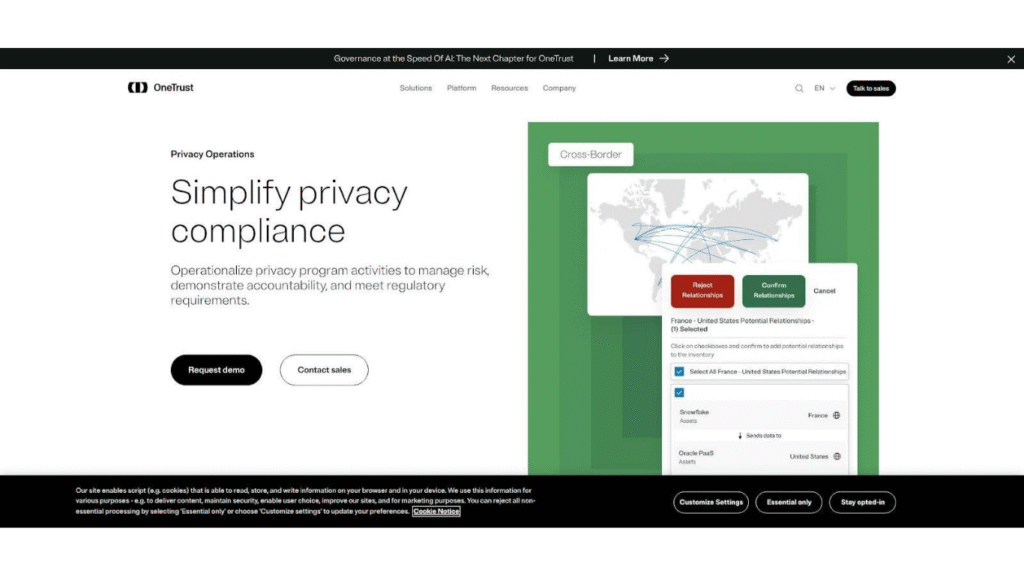
Hospitals value breadth. When a team must run a Data Protection Impact Assessment before launching a new patient app, OneTrust delivers a guided questionnaire, risk score, and mitigation plan in a single workflow. The same portal manages vendor risk reviews, cookie banners, and DSAR queues, so your privacy office finally lives in one tab.
The trade-off is complexity. A steeper learning curve pairs with a price tag that starts where many SaaS plans top out. Plan for a dedicated admin or consultant during rollout; the payoff is a system that scales with every new clinic, state law, or EU guideline.
3. BigID: x-ray vision for PHI and personal data
You can’t protect what you can’t find, and BigID finds nearly everything. Point it at cloud buckets, SQL clusters, SharePoint drives, or that dusty on-prem file server, and the platform surfaces every row, column, and PDF that resembles PHI or EU personal data.
The strength lives in its classifiers. BigID recognises ICD-10 codes, insurance numbers, and free-text diagnoses, then labels each hit with “EU resident,” “special-category health,” or “exported to U.S.” flags. Your Article 30 record and HIPAA asset list almost write themselves.
Discovery leads to action. Spot PHI stored unencrypted in a development S3 bucket? Trigger a ticket. Find data older than the retention policy? BigID can mask or delete it on schedule.
Set-up requires care. Scans require tuning, false positives require triage, and licence costs favour large enterprises. Yet for sprawling hospital networks facing shadow IT, the visibility return often outweighs the effort. Treat BigID as the flashlight, then let your GRC or SIEM tools handle the fix-ups.
4. Securiti: AI-driven PrivacyOps in one box
Securiti aims to be the single platform where data discovery, consent, DSAR fulfilment, and incident response work together automatically. Connect your databases and SaaS apps, and its AI engine builds a People Data Graph that links each patient, each record, and each consent flag across clouds and continents.
The payoff is speed. A GDPR access request arrives, the bot assembles the data packet, flags PHI for redaction, and routes it for legal review. A breach alert fires from your SIEM, Securiti cross-references the graph, calculates notification obligations under both laws, and launches a task list before your espresso cools.
Healthcare perks include PHI classifiers out of the box and vendor-assessment workflows that track BAAs beside GDPR DPAs. Drawbacks remain: enterprise pricing pairs with a learning curve anchored in setup wizards, and early scans create false positives that require tuning. For data-heavy organisations chasing continuous compliance in real time, Securiti’s integrated approach looks forward—one platform, one data inventory, zero swivel chair.
From short-list to signed contract
Choosing a tool is only half the win. Real value appears when alerts fire, DSARs close on time, and auditors nod instead of frown.
Secure executive backing first. Share the cost-of-non-compliance numbers: GDPR fines now average about €2.8 million, and HIPAA breaches cost more than $500 per compromised record. Budget conversations move quickly when leaders see those figures.
Sign the paperwork before touching the tech. Any vendor that handles PHI requires a Business Associate Agreement, and EU data needs a GDPR data-processing addendum. Legal signatures up front prevent go-live delays caused by contract limbo.
Phase the deployment. Begin with one high-value integration, often the primary cloud account or EHR. Fix the red findings, prove quick wins, then expand to secondary systems. Momentum beats a boil-the-ocean approach every time.
Validate early. Run a mock audit after the first month: can the team pull ninety days of access logs in under five minutes, and export a DSAR history with timestamps? If not, adjust configurations before bad habits are set.
Finally, train the humans. Automation gathers evidence, not accountability. Set up weekly Slack digests of failed controls, rotate ownership, and celebrate the first time an alert prevents a real incident.
Conclusion
Follow this path and the tool purchased this quarter keeps delivering next year, even as regulations—and stakes—rise.
Article received via email