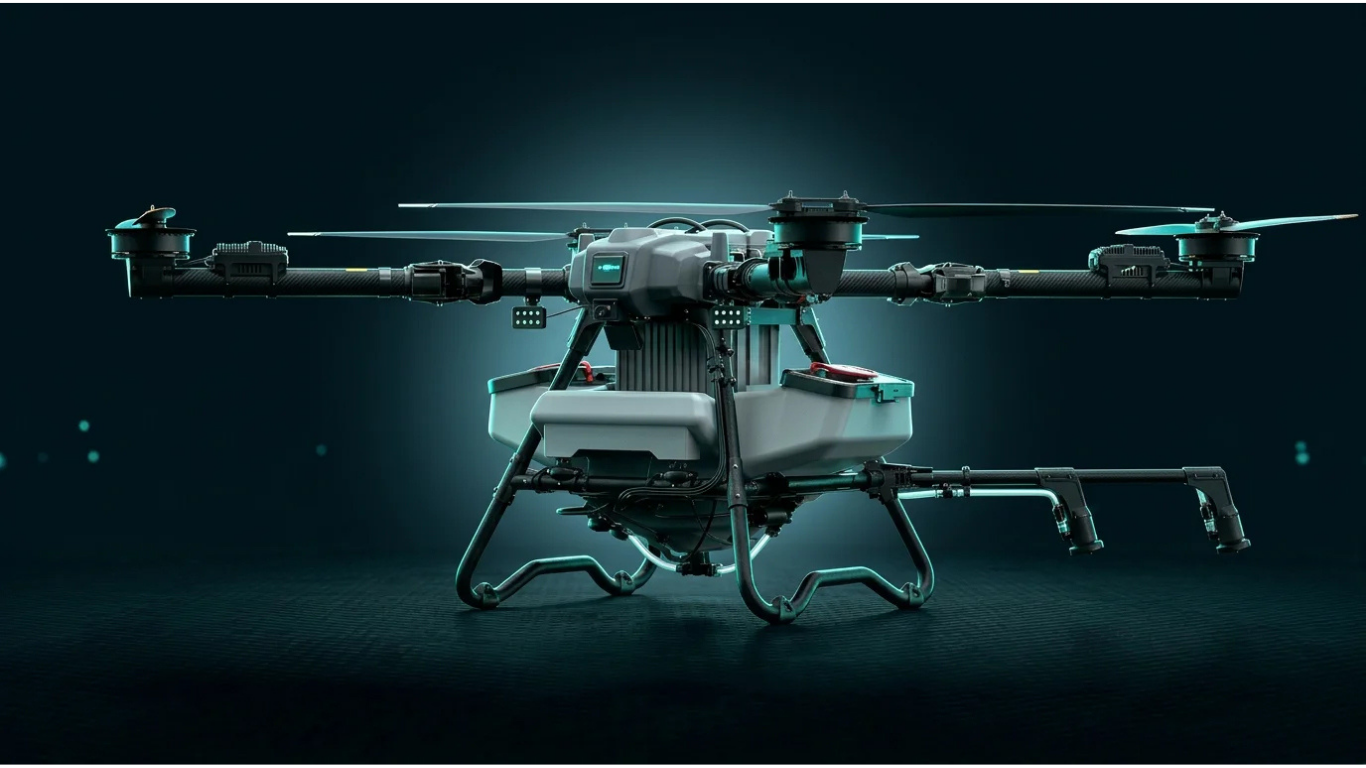
DroneDash Technologies and GEODNET, one of the world’s largest decentralized GNSS-RTK network, recently announced the formation of GEODASH Aerosystems Pte. Ltd. — a Singapore-incorporated joint venture developing a new class of agricultural spraying drone engineered for large-scale, industrial farming operations.
Unlike conventional agriculture drones that require repeated manual pre-mapping before each deployment, GEODASH Aerosystems’ platform uses real-time AI Vision and centimetre-accurate RTK positioning to perceive, navigate, and adapt dynamically during flight. The result: faster deployment, lower operating costs, and continuous agronomic intelligence — from the same system that does the spraying.
The Problem with Conventional Agriculture Drones
Most agricultural spraying drones in operation today were adapted from general-purpose UAV platforms. Before each deployment, operators must manually survey and map the field, generate static flight plans, and repeat the entire process whenever terrain, planting patterns, or canopy profiles change. In oil palm plantations and large-scale row-crop environments, this mapping overhead directly limits how many hectares a team can cover — and how quickly they can respond to emerging crop conditions.

The operational constraints are compounded as estates scale:
- Manual pre-survey and field mapping required before each deployment
- Static flight plans that must be recreated when terrain or canopy profiles change
- Limited adaptability to uneven terrain and mixed-age crops
- Repeated mapping cycles after replanting, pruning, or erosion events
A Drone Platform Built Around Dynamic Intelligence
GEODASH Aerosystems’ drone architecture removes pre-mapping from the deployment workflow entirely. Using DroneDash’s proprietary AI Vision system, the aircraft performs real-time perception of plantation structure, canopy height, and terrain features during flight. GEODNET’s RTK correction network delivers centimetre-level positional accuracy throughout each mission.
This combination enables:
- Deployment without pre-mapping or manual mission surveys
- Dynamic interpretation of rows, trees, and operational zones
- Continuous altitude and spray-rate adjustment over variable terrain
- Rapid redeployment after replanting or field reconfiguration
- Tree-level and zone-specific variable-rate application
Situational awareness is generated dynamically during flight — not through a separate pre-deployment process. Each aircraft maintains geofencing controls, safety constraints, and full operational data logging for regulatory compliance and audit traceability.
Beyond Spraying: An Agronomic Intelligence Layer
Each GEODASH Aerosystems drone is integrated with DroneDash’s AI Smart Farming backend, which transforms every operational flight into a continuous data-collection activity. Spraying missions generate field data used to produce:
- Canopy density and uniformity analysis
- Crop stress and anomaly detection
- Zone-level health scoring
- Spray effectiveness validation
- Terrain and drainage profiling
- Historical trend analysis across blocks and seasons
Backend AI analytics then deliver actionable decision support to plantation managers and agronomy teams: early indicators of pest, disease, or nutrient stress; identification of underperforming zones; optimised spray timing and dosage; and data-informed planning for replanting and fertilization. The drone functions as a continuous aerial intelligence layer, not a standalone spraying machine.
Executive Commentary
“Agriculture does not need bigger drones — it needs smarter ones. By removing repeated manual pre-mapping and integrating AI Smart Farming intelligence into every flight, we are turning spraying drones into tools that both execute operations and inform agronomic decisions. Plantation operators can move faster while improving consistency, efficiency, and outcomes.” — Paul Yam, CEO, DroneDash Technologies and GEODASH Aerosystems
“When centimetre-level RTK positioning is combined with real-time perception and backend analytics, autonomy becomes predictable and reliable. GEODASH Aerosystems demonstrates how precision positioning infrastructure can enable both accurate operations and continuous data-driven agriculture management.” — Mike Horton, Founder, GEODNET and Co-Founder, GEODASH Aerosystems
Markets and Commercial Timeline
GEODASH Aerosystems is targeting industrial agriculture markets where deployment speed, terrain adaptability, and precision matter most: oil palm plantations in Southeast Asia; sugarcane, soybean, and corn operations in the United States; and palm, sugar, and broad-acre estates in South America.
Pilot deployments and system validation have been conducted throughout 2025 and into early 2026 in collaboration with plantation operators. Commercial deployment is targeted for Q3 2026, following completion of manufacturing readiness and regulatory approvals.
For similar news on Drones, please read: From Static to Cinematic: What FPV Drones Bring to Visual Storytelling