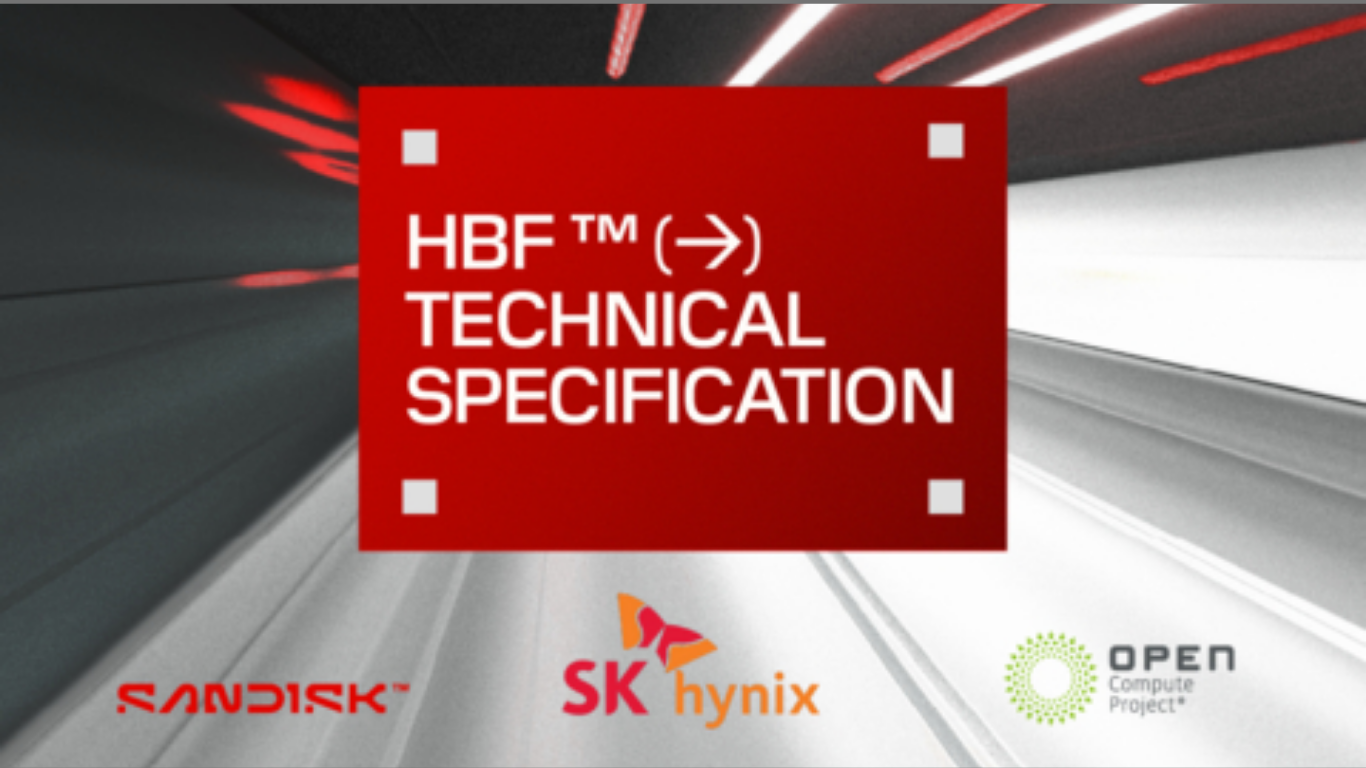
Sandisk Corporation (Nasdaq: SNDK) and SK hynix Inc. recently announced the release of the HBF (High Bandwidth Flash) technical specification through the Open Compute Project (OCP), advancing the workstream to drive HBF standardization for the AI inference era, just six months after the consortium began work in February.
The specification was developed through the HBF technology workstream under OCP, with Sandisk and SK hynix serving as primary contributors. Notably, Google and Tenstorrent joined as consortium members during this standardization process, contributing significantly to technology validation and the establishment of the standard. The specification provides companies and developers designing AI inference systems and accelerators with a common technical framework for incorporating HBF technology where larger, near-compute memory capacity and higher bandwidth are needed to improve power and performance metrics and help reduce total cost of ownership.
Modern AI inference systems need high-bandwidth memory positioned close to compute cores, while the demand for greater near-compute memory capacity continues to grow with the requirements of large language models and emerging AI workloads. HBF technology is designed to address this need by combining high bandwidth with high capacity, helping data center system designers improve interactivity and throughput during model serving.
“AI inference is creating a new set of memory requirements, and HBF technology is designed to meet that moment,” said Alper Ilkbahar, Chief Technology Officer, Sandisk. “This specification helps give system designers a practical path to bring high-capacity, high-bandwidth memory closer to compute, while enabling more flexible architectures. It is an important milestone for the HBF ecosystem and for the next generation of AI systems built to improve token economics at scale.”
The specification defines system interface, electrical and other technical guidelines for designing systems that interact with and use HBF technology, including basic performance expectations, the xPU-HBF host interface, reliability and packaging guidance for an HBF die stack, and a software user guide for read and write operations. As one of the first technical standards of its kind in the memory and storage industry, the specification helps give AI compute system designers added flexibility to build systems where HBF technology can coexist with High Bandwidth Memory, helping support ecosystem readiness.
The specification was released within the Open Compute Project framework, meaning the information is openly available to the industry. Sandisk and SK hynix proactively published the specification to position HBF technology as the de facto standard in the rapidly evolving AI storage market. Their strategy involves fostering an early-stage ecosystem, increasing the visibility of HBF technology’s adoption for customers, and accelerating market expansion and technological maturity through open collaboration and membership in the consortium.
Sandisk Keynote: NAND – The Versatile & Scalable Foundation of the AI Era
On Wednesday, August 5, at 11:40 a.m. PT, Sandisk’s keynote at The Future of Memory and Storage Conference (FMS) at the Santa Clara Convention Center will explore the importance of system-level optimization and NAND in enabling AI inference at scale. The keynote will feature Sandisk’s Jim Elliott, chief revenue officer; Khurram Ismail, chief product officer; and Alper Ilkbahar, chief technology officer.
FMS Panel Discussion: Breaking the Memory Wall with High Bandwidth Flash
On Thursday, August 6, at 9:45 a.m. PT, Sandisk, SK hynix, and Google will present a panel discussion hosted by Thomas Coughlin, President of Coughlin Associates, at The Future of Memory and Storage Conference (FMS) at the Santa Clara Convention Center, Conference Room D. The session will discuss how HBF technology aims to redefine the memory hierarchy by providing near-memory speeds with the density and persistence of high bandwidth flash. The panel will bring together experts from HBF solution providers as well as a Hyperscale-AI Infrastructure provider, to dissect the HBF technology usage and development needed for success, including Architectural Integration, Technical Challenges, Standardization timelines, performance and economics.
For similar news on Sandisk, please read:
1) SanDisk Begins Sampling BiCS10 1Tb TLC 3D NAND Flash
2) Kioxia and SanDisk Launch Advanced Fab2 Operations in Japan